A fluorescent rose in my garden.
No matter when you start, it is important that you do not stop after starting. No matter when you end, it is more important that you do not regret after ended.
Thursday, December 25, 2008
Wednesday, December 24, 2008
A mountain of maintenance
I've been wondering about the upper mountain. It must be snowing up there today, because the temperatures are much cooler here in Longmire. The Camp Muir and Paradise weather stations are both offline... Perhaps they are casualties of the intermittent disruption of power, phone and internet. I do know this: there was 7 inches of snow on the ground at Paradise yesterday, and I can see a snowline at 3,500 feet today.
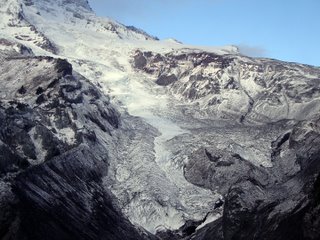
I am also wondering about all that rain on the glacier. I have a feeling that at some elevations, the rain turned the glacier into hard/bulletproof ice when the temperature dropped. Here is the Nisqually Glacier from the air, taken on Wednesday.
It has been raining steadily today, but the river flow and currents have remained normal. Access to the backcountry and mountain is dependent upon repairing the park's infrastructure. A lot of cranes, dozers, and dump trucks will be needed to re-sculpt the land for roads and sewer systems. Like today, I saw a large crane moving rock in the Nisqually River in order to help protect a historic cabin, road and treatment plant. But it's not everyday you see this sort of thing in a national park.
There was another spate of articles online at MSNBC and in the local papers about the park closure and flood damage. The big pieces were in the News Tribune, Seattle Times and the Yakima Herald. In the meantime, let there be colder temps and stable weather.
I am also wondering about all that rain on the glacier. I have a feeling that at some elevations, the rain turned the glacier into hard/bulletproof ice when the temperature dropped. Here is the Nisqually Glacier from the air, taken on Wednesday.It has been raining steadily today, but the river flow and currents have remained normal. Access to the backcountry and mountain is dependent upon repairing the park's infrastructure. A lot of cranes, dozers, and dump trucks will be needed to re-sculpt the land for roads and sewer systems. Like today, I saw a large crane moving rock in the Nisqually River in order to help protect a historic cabin, road and treatment plant. But it's not everyday you see this sort of thing in a national park.
There was another spate of articles online at MSNBC and in the local papers about the park closure and flood damage. The big pieces were in the News Tribune, Seattle Times and the Yakima Herald. In the meantime, let there be colder temps and stable weather.
Please, Do Your Family a Favor...
My Mother passed away last week (Tuesday, February 15th) and due to her foresight and thoughtfulness, the days following her death were somewhat less stressful than they might have been.
You see, back in January of 1999 Mom planned her own funeral, decided where she was going to be buried, selected the grave marker – and paid for it all!
She purchased the cemetery plot and grave marker outright and got an “insurance policy” to pay for the funeral services. Premiums were paid for three years and guaranteed the cost. She also discussed those arrangements with me, so I knew what she wanted.
She had selected only one song for the service so we chose several more that we knew she liked. The only things that were left to decide and pay for were the flowers for the casket, the funeral cards, thank you notes, and the obituary notices.
The other thing that Mom did that made our decision for us when the time came, was that she discussed her wishes in regards to “heroic measures” or life support in the event that she became terminally ill. It was a heart-wrenching decision that was by no means easy, but essentially one that she had made and we were bound to honor that decision.
Last November, Apple wrote about the process she went through in pre-planning her Mother's funeral as well as selecting a burial site and grave marker. Tough decisions were made and it was stressful, but imagine having to make those decisions in a very short period of time and under even more stressful conditions.
It is definitely not an easy task, but one which your family will forever be grateful. So, if you can, get your funeral planned. At the very least, discuss your wishes with your family. And, if at all possible get it paid for. Now.
Thank you, Mom, for this gift that you gave us.

Mom was cremated and the cremains were buried in the plot shared with her sister at Lakeview Cemetery, Larwill, Indiana. Mom selected a bench marker so that we might have a place to sit when visiting her.
Tuesday, December 23, 2008
Fashion Friday
At the request of Lotus, over at Red Phoenix Style, I've included some shots of what's hot at the crag right now.
Here's Sister Matt bringing vinyl snake skin to the sport. Surely a first, and so practical, windproof, dust resistant and looks so good.
Here's Oli channelinga Caribbean Pirate
And his fabulous shabby, pirate, rasta details.
Massive lats never go out of style, don't you think?Antoine sported his and twin chalk bagsas he crushed "Separation Anxiety" 28
Always the corporate whore, I wore the Red Chili logo shirt in sky blue.
Thursday, December 18, 2008
The Cyclist and the Roundabout
Though not nearly as widespread as in the UK, roundabouts - also known as rotaries and traffic circles - are fairly common back in New England, particularly in the sort of areas that brevets and similar rides tend to take us through.Personally, I don't know anyone in the US - be they cyclist or driver - who actually likes roundabouts, and I am no exception. Over the years my attitude toward them has transitioned from one of pure terror to one of a more manageable, subdued loathing. There are right of way rules to navigating them, but somehow the traffic flow ends up being chaotic despite those rules. Drivers don't always yield to other vehicles correctly, and bikes they sometimes outright ignore. As a cyclist, you can end up waiting your turn forever despite having the right of way. Or worse yet, a driver's failure to yield once you're already moving through the circle can result in a close call or collision.
Now cycling in Northern Ireland, my relationship with roundabouts has moved to an entirely new, downright intimate level. On the North Coast they are everywhere, often used in leu of traffic lights, and I go through at least one - but more typically anywhere between three and six - every day. There are large roundabouts the size of parks. There are smaller ones that might display a modern sculpture or two. And there are tiny ones that are just painted circles on tarmac, easy to miss. There are urban roundabouts through which cars move at a crawl. And there are rural ones, through which lorries fly at top speed.
Most impressive of all are the roundabouts situated along steep hills. One such stunner is just outside of Limavady town, approaching the village of Aghanloo. When I first saw this thing appear in front of me, my jaw dropped. When approached from one direction, this roundabout requires being ready to yield or stop while climbing a 10% grade, from another direction while descending the same. And to be clear, the hill does not start or end with the roundabout; the intersection is half way through the climb. For a cyclist this can be rather ...interesting, requiring precise control of one's bike and brakes.
But one thing I realised about the roundabouts in Northern Ireland over time, is that they are predictable: There is no chaos or confusion, as everyone actually follows the right of way rules. Traveling on the left side of the road, you yield to traffic approaching from the right, and in the same manner other traffic yields to you. Unlike in New England, drivers do actually yield when it is another vehicle's turn - even if that other vehicle is a bike! It took me some time to trust in this, but once I started to all the stress from navigating the roundabouts was removed. When it's my turn, I go and when it's not, I stop: easy, and, admittedly, more efficient than a traffic light. I like it!
What has been your experience with roundabouts as a cyclist in the area where you live?
Miss Mercian: Then and Now
One of the things I was very much looking forward to on my trip to New York last week, was visiting Justine of Midlife Cycling. Justine is a fascinating, generous and knowledgable person and we have lots to talk about outside the world of bicycles. But more pertinently to this blog, Justine is known for her small, exquisite collection of Mercians. And so I happily found myself in Astoria, Queens, in an apartment that was eerily similar to my own in its proportion of total living space to the space devoted to bikes. Nothing wrong with that at all.
When I firstwrote about Justine and her Mercianstwo years ago, she had three of them - all custom made and painted the same stunning shade of "flip-flop purple green" (more on this later). One of these is a geared roadbike, the second is a fixed gear, and the third a Miss Mercian step-through. Subsequently, Justine unexpectedly acquired a fourth Mercian secondhand - an earlier Miss Mercian model, from an era when the design was still a classic mixte with twin lateral stays. Knowing this, I was looking forward to seeing the two generations of Miss Mercians side by side, and excited when Justine offered me to test ride both bicycles and compare my impressions. While her diamond frame bikes are too big for me, the lower step-over of the Miss Mercian frames enables me to try them.
Through the quiet streets of Astoria, we rode to the Socrates Sculpture Park to photograph the bicycles along the East River. The park is small, but very pleasant, with a cobblestone path along the water and views of Roosevelt Island and passing boats in background. It was a cold and windy morning, but at least the sun was out, bathing the bicycles in a golden light.
This is Justine's current production Miss Mercian, named Helene. My understanding is that Mercian switched to this frame style for their Miss Mercian model, because they only use Reynolds tubing and Reynolds stopped making the tubes suitable for classic mixtes a few years ago. I will be honest that I am not a fan of "angled step-through" frames. But the lugwork, the colour scheme, and Justine's very personal build make this bicycle rather charming.
One of my photographic goals for this bicycle was to capture the flip flop purple green finish in action. The beauty of this colour is hard to describe, but basically it's as it sounds: Under some lighting conditions it looks purple, under others it looks green. Seeing the colours change takes my breath away. Above I captured it in a very purple state, though usually it looks like a much more subdued silverfish lilac.
And here you can see what happens when the colour flips to green.
Neat, huh?
Flip-flopping in the sunlight! I love this colour and might have used it for my own bike were it not so distinctly Justinish in my mind. It is certainly one of the most unique paint finishes available.
But all right, there is more to this bike than its paint colour. Like Justine's other custom Mercians, the frame is lugged and made of Reynolds 631 tubing.
Helene is set up with Porteur handlebars, inverse brake levers, bar-end shifters adapted as "thumbies," side pull brakes, pedals with classic toe cages, hammered fenders, rear rack, a Brooks saddle and a
Carradice saddlebag.
Justine rides this bicycle in her regular clothing - skirt, heels, the whole deal - and it is her fast, responsive commuter. The geometry, which Justine specified, is pretty tight and aggressive, and she likes it this way. For her this is an upright, but maneuverable and go-fast bike.
Justine lowered the saddle for me and switched out the pedals to platforms, so that I could comfortably ride the bike around the unfamiliar-to-me area. When I rode this bicycle, the geometry - not the frame style, but the angles and proportions - struck me as an exaggerated version of my Royal H. mixte. My positioning on the bike was very similar as well. Unfortunately the angled step-through frame and I did not get along when it came to mounting and dismounting the bike: I found the top tube too high for me to comfortably climb over and kept banging my knee. I was also a little uncomfortable with the amount of toe overlap, and between this and the high top tube I felt oddly trapped by the frame, as if everything was too tightly spaced. Of course this says more about the difference between my and Justine's geometry preferences than anything else, but I was a little nervous on this bike as I followed her up the winding bridge ramp to Roosevelt Island. I did not want to crash the bike or to knock it over while attempting to dismount. Thankfully, nothing of the sort happened and we had a nice ride with scenic water views. As we rode, I noticed that the frame flexed for me a bit more than I would have liked, which is odd because Justine describes it as stiff. The subjectivity of this sort of thing is amazing.
Stranger still, is that Justine describes her older Miss Mercian as more flexible than the current model, whereas I found it to be stiffer. How can this be? Are we simply associating different sensations with the terms stiff and flexible? It's a mystery.
The day did not warm up despite the sunshine, and even though I had donned every single pair of stockings I'd brought with me to New York (three pairs!) I was uncomfortably cold. Between this and having to be across town by early afternoon, our ride was not very long. Still, I feel that I got a fair sense of the difference between the two bicycles - although since both of these are custom bikes made for specific people, I am not sure how generalisable my impressions are to Miss Mercians at large.
Overall, I felt more comfortable on the older (1994) Miss Mercian - with its longer wheelbase, lower stand-over and greater toe clearance. I also preferred this bicycle's ride quality and handling, which to me felt a bit cushier and more stable. None of this necessarily has to do with the styles of the two frames; it is more about geometry really. Still, I lamented that Mercian no longer makes the classic twin stay mixte - it was oh so elegant.
Justine's 1994 Miss Mercian is named Vera, and the original owner ordered the frame in English Racing Green with gold lug outlines.
The Reynolds 531 frame was built for cantilever brakes, and eyelets for fenders and front and rear racks.
The cable routing is kind of interesting, integrating nicely with the twin lateral stays,
then "climbing" up the seat tube. I have never seen this kind of routing on a mixte before, but I think it works well.
One of the cool things Justine has got on this bicycle, is this green and gold crankset with built-in chain guard. I have never seen one like it before, and it certainly makes the bicycle stand out as her unique creation.
I tried the MKS Lambda pedals for the first time and liked them a lot, even though I did not think I would. They are grippy, and not as sharp as MKS touring pedals.
Justine set up the older Miss Mercian similarly to the newer one, but with a front rack in addition to the rear, a single instead of a double chainring, North Road handlebars instead of the Porteurs, and flat pedals. This bicycle is a little more upright and relaxed, and set up to carry more weight than its sportier room-mate.
Justine has been riding bicycles for decades as a messenger, racer, cyclotourist, commuter - you name it. And she has owned an untold number of bikes over this time (I believe the estimate she gave me was 60?... but no, that can't be right!) This makes it all the more fascinating, that all of her current bikes are from the same manufacturer. Is it the Reynolds 631 tubing Mercian uses that she finds so agreeable? The way they put together frames? Do their notions of optimal geometry agree with her own? Whatever the answer, Justine seems to know what she wants and she is happy with her choices.
Of course I am trying to convince her now that she also needs to add this bike to her Mercian collection, then let me test ride it extensively. Fingers crossed!
For the entire picture set, please see here. And I thank Justine profusely for allowing me to try her beautiful bikes!
Subscribe to:
Posts (Atom)