Tuesday, November 16, 2010

Can Stop, Will Stop: TRP Mini-V Brakes

Honey Cyclocross, Winter Lilac

I have embarked on a long term test ride of a Honey cyclocross bike, similar to the one I rode in the Kearsarge Klassic last summer. When asked about component preferences on the demo bike, one thing I requested was stronger brakes. I had remarkably poor stopping power with the cantilever brakes on the bike I'd borrowed earlier, and I generally have not had good luck with cantis. I described these problems to Honey and we decided to try v-brakes. They suggested the TRP CX8.4 "mini-vs."


The TRP CX8.4 linerar pull brakes were designed for maximum stopping power oncyclocross bikes. Unlike full sized v-brakes, they were also designed to work with integrated road levers (this particular model works best withCampagnolo and SRAM)without requiring an adapter- reducing bulk, weight and complexity. These brakes have a number of features to recommend them for cyclocross racing, but having no experience with that side of things I will stick to describing them in the context of "just riding."


Under my weak grip, theTRPs feel reassuringly powerful. Those with strong hands could in fact find this problematic, but for me it is a welcome change from having to worry about stopping a fat-tire roadbike with cantis at the bottom of a hill. This is the first time I have used v-brakes on such a bike, and the quality of the braking does feel different from centerpulls and cantilevers. I have to apply pressure differently to regulate exactly how much I want to brake, but it didn't take long to train my hands to "understand." When attempting to slow down at high speeds, the braking is not harsh or jerky, but it is stronger than typical - so it helps to have a gentle touch, or else to use only one finger on the lever. For harder braking, there is a luxurious, modulation-friendly margin before coming to a full stop that I find especially helpful. In the past, I have had to get creative in order to stop on downhills during unpaved rides, and I've even employed my foot as an auxilliary brake on a couple of occasions. The TRPs are at their best precisely in those situations.


I have ridden the bike only a couple of times so far, but our winter conditions have allowed me to immediately try it on snow and slush. Getting the rims slushy did reduce braking power, but there was so much of it to begin with that it remained manageable. Basically, with the mini-vs the bike rides with slush-clogged rims like it did with dry rims when it had cantis.


The Honey cross is set up with a carbon fiber fork, and I have not detected any judder with the TRPCX8.4s. These brakes easily clearthe 700Cx35mm tires currently on the bike, and look like they could fit a fender. My understanding is they will not clear a 650B x 42mm tire; for that full sized v-brakes may be required.


With an MSRP of $149 per set, the TRP CX8.4 brakes seem like an excellent and accessible option for those seeking extra braking power on a roadbike with canti/v bosses. As I get the opportunity to try other brakes worth mentioning, I will continue the "can stop, will stop" series (See also: Paul Racer centerpull brakes).

Sunday, November 7, 2010

Foggy Fall Morning


Taken Saturday morning of last weekend. An overnight low temperature of 28 degrees made for some beautiful fog over the inland lakes Saturday morning. Fog combined with fall colors... not many things make for better photos conditions!

More fun with fungi

Fungi are one of the more frustrating things to try to identify. I thought bugs were bad, but at least BugGuide is pretty dang inclusive. No such comprehensive reference exists for mushrooms, so far as I know.


You'd think this sweet little cup-type would be easy to identify. I was thinking, well it looks like a bird's nest fungus, only without the "eggs". But I can't seem to find any reference to anything like that, not to one that isn't "densely hairy" anyway. Maybe its hairs are all repressed, what with the drought...?


Sometimes it helps to just google what something looks like. (The top search term that finds this blog has been "yellow fuzzy caterpillar" for over 2 years now.)

But trying to find "yellow sandwich fungus" didn't do me much good.


I do believe it's the same fungus as this one, which he calls Stacka hydnum (which you'd think would be the scientific name, but isn't). But other pictures of Climacodon septentrionalis (the real scientific name) look completely different to me.

Then there's this black stuff.


If you look at this site, you'd be pretty convinced that it's Diatrype stigma, common tarcrust.


But if you went by this image, or this one, you might not.


And is this even the same black stuff? It seemed thin and crusty, whereas the others were thicker and sort of... puffed.

I do think, after looking at several images for common tarcrust, that it's what I've been seeing when it seems like there are several old burned branches in an area with no other signs of fire.

Monday, November 1, 2010

More Digging


These photos so a little of how deep the tractor had to dig to get down to the bottom on the fence across our back yard. About 3 feet. Couldn't beleive that much dirt had drifted against the fence in the 9 years we have been here. Our neighbors was about as deep and they have only been there 6 years. Dug a hole and burried all those sunflowers. My blind horse, Star didn't pay much attention to the tractor. Neither did any of the other horses. I did keep the dogs and cats in the house while it was working so we didn't take any chances on them getting under it.


Sunday, October 31, 2010

Santa Hat

Sonny agreed to pose in the Santa Hat as did all the other horses and ponies and even our cat Murphy who can be see at the end of this blog'

Thursday, October 28, 2010

Gunks Routes: Gaston (5.8-)


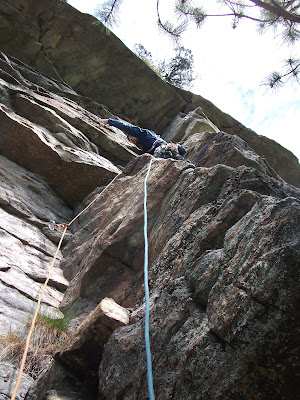
(Photo: Past the pro-less start on Gaston (5.8-).)


Maryana and I were looking for something new to do on a beautiful Saturday in April, and it seemed like if we wanted something out of the ordinaryour timing couldn't be better, since we might not have any choice in the matter.We arrived at the West Trapps lot in the morning to find it was already nearly full, even though the temperature was still in the low 40's.As we walked down the carriage road it seemed like all theusual suspect climbswere occupied. It was the perfectoccasion for usto jump on something unpopular, something obscure.


When wepassed the connector trail I looked up at the cliff and saw theexpected sights. Climbers were on Arch (5.5). Climbers were on Strictly From Nowhere (5.7). But as usual no one was on the no-star climbs nearby: Calisthenic (5.7), Gorilla My Dreams (5.7), or Gaston (5.8-). And no one was on Splashtic (5.10a), a climb which gets a star from Dick Williams but which seems always unoccupied because the first pitch is 5.10 and the second is 5.9 R.


I was intrigued by Splashtic, because it seemed from the description that the crux is really one move, early in the first pitch. Looking it over on Saturday, I thought it looked doable and protectable. Maybe this was a good 5.10 candidate for me? I wasn't interested in the R-rated second pitch (although it sure looks exciting...) but I figured we coulddescend from the threaded anchor atop pitch one or continue with the upper pitches of another climb.


I was also interested in Gaston, because it has a reputation for being underappreciated and somewhat tricky for its 5.8- grade. I'd heard the upper pitches, which are just 5.5, were also good.


Maryana thought Gaston was a better choice for a warm-up than Splashtic so we were set.


Dick's guidebook describes the first pitch as going up a ramp and then moving right past a bulge. Then thin climbing left past two pins was supposed to be the crux.


For me the crux of pitch one was the lack of pro low on the pitch. There is nothing for at least fifteen feet or more. I went up the easy ramp and then expected to find something. But I didn't.


Then another move up and left onto a ledge. Still pretty easy climbing, but I was still lookingin vain forsome placements.


Finally I found gear, but it was to the left of the route. Theclimbingclearly went to the right through the bulge. I had two pieces but they were off-line.


After trying out a couple of different approaches I committed to the surprisingly thin holds and got through the bulge.


Then I think I got another piece, something micro, before moving up and left to an angle piton. (Dick mentions two pins but I guess one has since disappeared.) I don't remember these supposed crux face movesas tricky. There was nothing as thin as the move at the bolt on Wonderland (5.8-), for instance. All I really rememberwas wishingI had more confidence in the gear.But once I clipped the pin it seemed everything would be okay. The rest of the way I felt both the climbing and the gear were casual enough.


At the end ofthe pitchI felt like in retrospect there was JUST enough pro. And the climbing was nice; it was clean andinteresting. Maryana pointed out that I'd missed the key placement. There is a place right below the bulge where a runner could be threaded. You can see it in the above photo over to the right of where I have a sling connected to the blue rope. I had pro at the same height but off to the left. It would have been better-- I would have felt better-- if I'd found this placement.


(Photo: Maryana at the final overhangs on the 5.5 pitch two of Gaston.)


The next surprise on Gaston was that the threaded anchor atop pitch one was gone. I built a gear anchor and brought Maryana up. We had been thinking we'd rap after pitch one and go do something else, but nowwe wereforced to do at least one more pitch.


Maryana led pitch two and itturned out to bevery nice. We both enjoyed it. While pitch one features interesting face climbing, pitch two is moretypical Gunks terrain, with good features in a huge corner systemand plentiful horizontals, leading up and left to some final overhangs with jugs.


One we reached the GT Ledge we had an easy walk over to the bolted rappel route to our left. But I thought it was a waste not to finish the climb. We'd come this far. Would we ever bother to come to this spot again? Might as well do pitch three. It looked like a short romp up to a roof. Why not do it?


(Photo: Most of the way through the 5.5 pitch three of Gaston.)


I led the pitch in about five minutes. I'm glad we did it. It reminds me of the top pitch of Minty. It is a little harder and the move out to the roof is a bit more exposed. But it is very similar, featuring a nice corner and then another juggy overhang. Good fun.


I think Gaston is definitely underrated at no stars. It has a lot of quality climbing. Each pitch is worthwhile. The rock is good. It is clean. It should have at least a star. I think if the two 5.5 pitches were not guarded by the tricky pitch one this climb would beextremelypopular with new leaders.


As it is it should be more popular with moderate leadersof all levels of experience.